


What's in Flight
Spring 2027
Dragonflies’ Extraordinary Migrations
Every year, Carl Schurz Park is host to one of the Olympians of the insect world, the dragonfly, who undertakes one of the longest fall migrations on the planet, and a creature who is also the oldest winged animal on earth.
On cool September and October afternoons before sunset, in open areas like the North Lawn and Hillside Lawn in Carl Schurz Park, it is possible to be caught in one of the most beautiful migration moments, when a swarm of shimmering winged dragonflies with their unmatched aerial grace come down low to the ground to feast on mosquitoes, midges and gnats. They swoop and dart, circling around and around in a feeding frenzy that can last up to 20 minutes or more. Their massive globe-like eyes allow nearly 360-degree vision. They have 30,000 lenses per eye (as compared to just one in humans), which enables them to process color and motion at lightening speeds.
Dragonflies are thought to be the oldest flying creatures on the planet, with fossil samples dating back 350 million years, long before dinosaurs roamed the earth. Early species of dragonfly had huge wingspans exceeding two feet and would by today’s standards be a terrifying sight. Ben Price, a principal curator in the Department of Life Sciences at the Natural History Museum in London thinks one reason they grew so large was that in those days there was a much higher concentration of oxygen in the atmosphere, and also they had no aerial predators until birds evolved from dinosaurs, at which point the dragonflies became smaller and faster to escape being eaten.


Twelve-spotted Skimmer by Ken Slade
Eastern Amberwing by Vicki DeLoach
Close up of Blue Dasher’s eyes
Painting of a 350-million-year-old dragonfly courtesy of the Natural History Museum, UK

Fossil relative of the modern dragonfly
Modern dragonflies are considered one of the most beneficial species in the park’s ecosystem. They hoover up pests such as mosquitoes that can carry infections harmful to humans. They have no stingers and have jaws too small to break human skin. Even the largest dragonflies are not aggressive unless trapped and handled roughly. Also, dragonflies form part of a rich food web as prey for the park’s birds and mammals

Blue Dasher by Deborah Bifulco

Jessica Ware, Curator and Chair of the Invertebrate Zoology division of the American Natural History Museum, who researches dragonflies’ extraordinary long-distance migrations, says there are 18 species of migrating dragonfly in the US and at least four of them pass through our park in spring and fall including the Wandering Glider, the world champion of insect flight.
Wandering Glider by Budak
In 2009, it was discovered that Wandering Gliders were undertaking the longest nonstop migratory flight of any animal relative to its body size. These tiny two-inch long creatures would fly nonstop for 3,700 miles across the Indian Ocean to East Africa, where a future generation would be born and then a third generation would return in the Spring across the Indian Ocean making a round-trip total of over 7,000 miles. ‘They were gliding using the winds around the equator called the Intertropical Convergence Zone,’ explains Jessica. These same weather fronts scoop up millions of smaller insects such as aphids, midges and spiders creating a floating buffet for the dragonflies.
The ariel success of the Wandering Glider, a beautiful tawny-yellow to golden-orange insect, is due to its clear, heavily veined wings, which have immense structural strength, and their exceptionally wide hind wings that function like a sail plane, with maximum lift and glide efficiency for long haul flight.
The Wandering Glider is found on every continent except Antarctica, and from sea level up to 20,000 feet in the air flying over the Himalayan mountains. In the fall, on America’s Northeast Coast, Wandering Gliders fly south from Canada, through New York City, down to Mexico and the West Indies, a journey of 1,500 to 2,000 miles.
Green Darner by Jim McCullough
One of the first dragonflies to arrive in our park in the spring (in April and early May) and often the last to leave in the fall (in September to mid and sometimes late October) is the Green Darner with its emerald green thorax. Males have a striking blue abdomen that acts like a peacock tail to attract a mate. In dragonfly parlance, Green Darners are ‘hawkers’, designed for agility and speed bursts of up to 35 mph and they are large enough to tackle substantive prey such as wasps, flies, butterflies, even other dragonflies and hummingbirds. They have five eyes, including three tiny additional eyes on top of their head that act like a gyroscope to maintain stability during acrobatics.
Wandering Glider male and female pair by Yuan Aves


Black Saddlebags by Tom Benson
As cold-blooded creatures, dragonflies need the sun’s warmth to keep their muscles limber to hunt for long hours. Some wing patterns are designed to trap heat. The Black Saddlebags (another migrant that passes through our park) is notable for its velvety black thorax, and clear wings with black patches that look like a pair of miniature horse saddle bags. These dark pigmentation patches absorb solar radiation and help to quickly warm up flight muscles on chilly mornings. Black Saddlebags are tireless aerialists who scoop up prey with their legs forming a basket, and often eat on the wing. When they do rest, they hang vertically from a twig.

Blue Dasher ‘the obelisk posture’ by Deborah Bifulco
Of course, too much heat can be a disadvantage. It is not unusual to see a Blue Dasher, a beautiful metallic blue dragonfly, (who is also a migrant traveling through our park), doing what looks like a handstand called ‘the Obelisk Posture’, with its abdomen pointing straight up in the air. This is a cooling behavior designed to minimize body exposure to the sun.
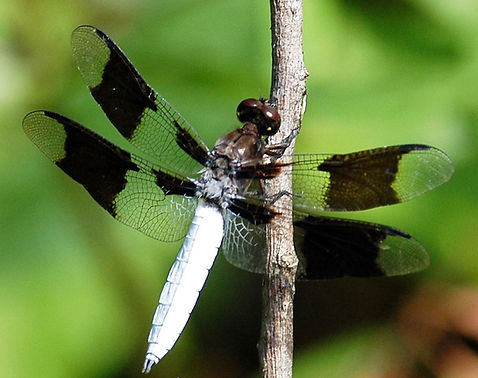

Common Whitetail by Jimmy Smith
Eastern Pondhawk by Jimmy Smith
In the fall, when temperatures consistently drop below 50 degrees Fahrenheit, dragonflies muscles stiffen which makes it hard for them to fly and feed. This is when most of the 328 dragonfly species in the US die off, or migrate. The four migrating dragonflies that pass through our park like the Green Darner move south, funneling in large swarms (sometimes in the millions) down the Atlantic coastline to the Southern US, Mexico and the Caribbean to breed and over winter.

Princeton Professor Martin Wikelski
tracking migrating Green Darners
‘People have been interested in dragonfly migrations for over 100 years. But its only in the last 15-20 years we have had the tools to prove their flight,’ says Jessica Ware. In 2005, a Princeton University scientist captured 14 Green Darner dragonflies in New Jersey and attached tiny radio transmitters (a third of the weight of a paperclip), using an improvised mix of eyelash glue and super glue, then chased them through the skies in Cessna aircraft to see where they went.

Elfin Skimmer dragonfly emerging from its nymph by Bryan Pfeiffer, (Chasing Nature substack)
A more common way to track a dragonfly’s migration is to examine the hydrogen isotopes in their wings. Hydrogen varies in weight north to south and east to west. ‘The hydrogen is like a chemical passport of the water where they were born,’ says Jessica Ware. All dragonflies start life underwater, most spend two-to three years as a water nymph undergoing five to 15 skin molts, before emerging as a shimmering winged creature.

Wandering Gliders mating in midair by Rison Thumboor
Some migrating dragonflies have evolved a very fast development cycle. The Wandering Glider doesn’t need anything as fancy as a lake or pond to breed. ‘It can lay its eggs in a rain puddle, and a juvenile Wandering Glider takes just six weeks to emerge,’ says Jessica Ware. Similarly, the Green Darner’s eggs hatch in about seven days and it emerges as a fully-fledged flying insect in three to five months. Green Darners who don’t migrate, stay as nymphs for up to three years submerged in lakes and ponds.

Slaty Skimmer by Vicki DeLoach
When spring returns, our four migrating dragonflies, the Green Darner, Blue Dasher, Wandering Glider and Black Saddlebags should reappear in the park between April and June, and hopefully also, there will be sightings of some of the 80 native non-migrating dragonfly species recorded by the NYC parks department. These include the beautiful Eastern Amberwing, Twelve-spotted Skimmer, Common Whitetail, Slaty Skimmer and Eastern Pondhawk.
Words: Lucie Young
Images: Vicki Deloach, Deborah Bifulco, Jimmy Smith, Tom Benson, Jim McCullough, Rison Thumboor, Yuan Aves, Ken Slade, Budak, Bryan Pfeiffer, (Chasing Nature substack)
Links:
American Museum of Natural History video ‘Dragonflies around the world’ by Jessica Ware