


Nesting Season is here!
Mallard duck and ducklings
A memorable moment in Carl Schurz Park was the hatch out of a flock of Mallard ducks near the 86th Street entrance. The fluffy brown chicks began running all over the park, and conservancy Chair Judy Howard (with the help of a park visitor), had to herd them up onto the Esplanade and down the ramp at 81st street to beside the FDR Drive, where they could jump into the East River.

Blue Grosbeak using a snakeskin in its nest. Mark Greene, Macaulay Library
‘Birders love the spring bird migration, but for me the most exciting moment in the bird world is the huge pulse of activity in nesting season, the singing, nest building, the laying eggs, feeding the chicks and fledging. It starts in early spring and continues into mid-August.’ says Robyn Bailey, project leader of Cornell Labs NestWatch and creator of the Bird Academy’s new learning series ‘The Hidden World of Nests and Eggs.’

Mallard nest by Bill Davison
Robyn took time off from monitoring nests and rescuing chicks to tell us about the nesters in our park and the latest scientific findings from NestWatch’s 50 years of research. One of the most exciting new discoveries is that Mallard ducklings can communicate with the mother from inside the egg. ‘One study thought that the chicks chirp to tell the mother if their egg needs to be rotated. A little peep from inside could say, I'm too warm or too cool, it's time to turn me. They also chirp to synchronize their hatching and let the others know, ‘Hey, I’m ready it’s time to leave the nest, and we all need to hatch at once,’ says Robyn

Great Crested Grebes builds a floating nest - Uriel Levy, Macaulay Library
A bird’s nest (which is essentially a nursery for chicks) can be as elaborate as a 1-ton Bald Eagle’s nest, as minimal as a scrape on the ground. Some water birds, like the Mute Swans and Grebes seen in the East River, nest on a floating mound of vegetation. The White Tern doesn’t even build a nest. It simply lays a single egg on a tree branch, or ledge. When their chicks hatch, they have very strong claws to cling tightly to the branches.

The White Tern lays its egg on a branch

Hummingbird nest – Jenny Pansing
‘I think one of the neat things is that all birds, even tiny hummingbirds, are trying to lay the largest egg they can manage. They are putting all their energy into filling the egg with the most nutrients, fluid, water and proteins possible. They make those eggs one at a time,’ says Robyn. It takes about 24 hours for a small bird such as the Blue Jays or Northern Cardinals who reside in our park to lay one egg. Larger birds, like shore birds, lay an egg every two to three days. The biggest birds can take a week for one egg. Most birds only sit on the nest to incubate the eggs when the clutch is complete, so the chicks hatch at the same time.

Red-winged blackbird eggs – Edwin Wilke, Macaulay Library
The most beautiful eggs, according to Robyn are laid by three Manhattan regulars including two nesters in our park, the Red-winged Blackbird and the Common Grackle. Robyn also admires the eggs of the Baltimore Oriole, who nests nearby in Central Park. Their coloration is like a Japanese painting, as if droplets of ink are distilled into water, and they're just so pretty.
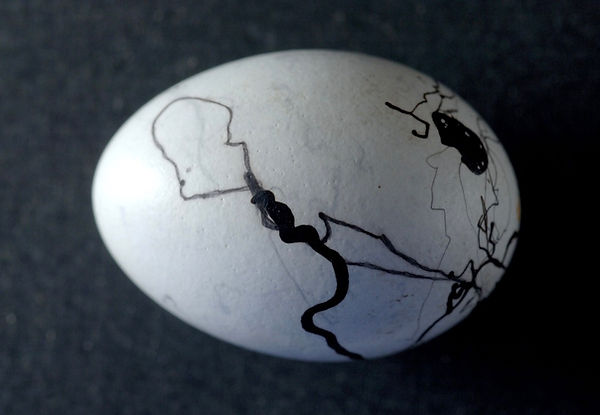
Baltimore Oriole egg – Ohio Department of Natural Resources
Each species of bird has a signature eggshell pattern. And like a fingerprint, no two eggshells are exactly alike. Eggs can be streaked, marbled, blotched or speckled. Birds in colder climates lay darker eggs to retain the heat better. Cavity nesters like woodpeckers (who nest in our park) tend to lay plain white eggs to make them visible in dark tree hollows.
.png)
Gray Catbird nest by JM Kosciw, NestWatch
Most egg patterns are a form of camouflage, but the blingy bright blue eggs of the Gray Catbird and the American Robin (who nest in our park) have defied logic until recently. According to Robyn, one theory is that the color may be signaling to their male partner, ‘look at these beautiful eggs’, to encourage the male to bring food to the mother and the chicks, and also to defend the nest, instead of starting a second nest with a new mate.

Common Murre cliff nesting by Aaron Skelton, Macaulay Library

Pointed Common Murre eggs - Peter Castell, Macaulay Library
The eggshell, which serves as a protective, breathable barrier, is thickest at the pointed end and thinner at the blunt end, which is where the chick emerges. The widest bit in the middle of the egg is also thicker, where it's likely to bump into another egg in the nest. Pointy eggs, like the beautifully colored ones laid by the Common Murre, have more impact resistance. A useful feature for eggs laid on a cliff edge.

Wilson’s Warbler feeding a giant Cowbird chick
It is common for birds to sit intermittently on the nest during the day and more constantly at night when the temperature drops. The parents’ absence is a prime moment for brood parasites like the Brown-headed Cowbird to pop an egg into another bird’s nest. Cowbirds are particularly fond of using sparrows, robins, swallows, cardinals and Red-winged Blackbirds as surrogates to raise their own young.

Brown-headed Cowbird egg in Red-winged Blackbird nest – Shane Sater, Macaulay Library
Stranger still, some birds like Tree Swallows, Bluebirds and Mallards, who create their own nests, and are considered good parents, will sometimes pop an extra egg or two into another nest of the same species. ‘It is thought they are trying to spread the risk if their own nest fails. Not putting all their eggs in one basket,’ explains Robyn.

Killdeer broken wing display - Michael Schramm, US Fish and Wildlife Services
Many birds have developed ingenious methods to defend their nests from predators. The Killdeer (a bird recently spotted our park) will pretend to have a broken wing and run away from the nest to draw predators off their eggs. Black-capped Chickadees (also park regulars) cover their eggs with nest materials when they are out foraging for food. Vultures defend their nest by lying on the ground and pretending to be dead, and the Northern Fulmar, a subarctic seabird, can projectile vomit a foul-smelling acid up to seven feet. This orange goo, which even the baby chicks can project, destroys the feathers of the predators.

Temporary egg tooth on Mourning Dove chick – Peter LaBelle, Macaulay Library
To chip their way out of the egg, nearly all baby birds develop a special egg tooth. ‘It is a temporary little bump on the tip of the beak made of keratin and it falls off, or is reabsorbed within a few days of hatching,’ says Robyn.

Red-eyed Vireo chicks born naked and blind, by Alyssa DeRubeis, Macaulay Library

Red-bellied Woodpecker parent returning with caterpillars, Jack and Holly Bartholmai, Macaulay Library
The size of the egg determines how quickly the chicks will hatch. The offspring of small birds such as the Red-eyed Vireo (and most the nesters in our park) hatch out quickly, usually within a week or so. But a short incubation period means the chicks are born very dependent, usually blind and featherless and requiring a lot of the parental care for the first two weeks to keep them warm and fed. It is arduous work, for instance it requires chickadee parents to find 6,000 to 9000 caterpillars to raise one brood.

Kirtland's Warbler parent removing a fecal sac, Benjamin Clock, Macaulay Library
All that food results in huge amounts of poop. Fortunately, the offspring of many small birds such as Barn Swallows, American Robins, Blue Jays, House Sparrows, House Finches and Song Sparrows (all residents in our park) produce poop in a fecal sac. This tough mucus membrane encapsulates the feces like a diaper. Parents carry these sacs away from the nest to keep the nursery clean.

Canada Goose chicks – Brad Walker, Macaulay Library
Mute Swans, like those seen with their signets on the East River and shorebirds like our Mallard duck (who has returned several times to nest in the same spot), lay bigger eggs, with a larger yolk that can support longer development. As a result, these chicks are born with their eyes open and covered in down or feathers. Within a day or two these independent chicks can run and swim. The babies of Canada Geese can jump off a cliff and land in the water, says Robyn.
Words: Lucie Young
Images: A special thank you to the Macaulay Library photographers: Mark Greene, Uriel Levy, Edwin Wilke, Aaron Skelton, Peter Castell, Shane Sater, Peter LaBelle, Alyssa DeRubeis, Jack and Holly Bartholmai, Benjamin Clock, Brad Walker
And also, thanks to: Jenny Pansing, Bill Davison, JM Kosciw – NestWatch, Michael Schramm (US Fish and Wildlife Services) and the Ohio Department of Natural Resources
Links:
The Hidden World of Nests and Eggs is an extraordinary tour of the world of nests, eggs and chicks around the world, hosted by Robyn Bailey of NestWatch: https://academy.allaboutbirds.org/product/the-hidden-world-of-nests-and-eggs/
NestWatch sign up to monitor a local nest for Cornell Lab of Ornithology and/or learn more about the nesting behaviors of local birds, nestwatch.org
Check out our previous edition of What's in Flight